ANKURA SKY / HOTEL TECHNOLOGY

Security and IT

Control, reliability and one point of responsibility.

Video surveillance, IPTV headends, IT equipment supply, integration and technical support.

01

Building the system

Video surveillance quality is determined by more than camera specifications. The system begins with the right architecture: the number and parameters of video streams, network bandwidth, switch PoE budget, recording method and required archive depth.

Camera resolution, frame rate, compression type and recording mode directly determine network load and the required storage capacity. The disk system must therefore be calculated according to the actual data stream and the required video retention period.

For smaller systems, an NVR may perform this function. Larger properties use video servers, dedicated storage systems and VMS (Video Management System) platforms that provide centralized management for large numbers of cameras and multiple physically remote sites.
02

Camera placement

Correct camera placement often matters more than the number of megapixels stated in its specifications.

Every camera should be installed for a specific task: general overview, entrance or passage control, monitoring a defined area, or obtaining an image detailed enough for identification.

Placement takes into account installation height and angle, lens focal length, the direction in which people move, daytime and night-time lighting, backlight, infrared illumination, possible obstructions in the field of view and operating conditions.

The widest possible viewing angle is therefore not always an advantage. A camera may show a large area without providing the required detail in the specific zone for which it was installed.

03

Video analytics

Modern IP video surveillance works not only with images, but also with events.

Cameras and server platforms can detect and classify people and vehicles, monitor crossings of defined lines and zones, register specified event types, and substantially simplify the search for a required fragment in a large video archive.

Some analytics may be performed directly by the camera, while other processing is handled by an NVR or video server. The architecture is determined by the scale of the system, the required functions and the computational load.

04

Cloud solutions

Cloud services offer another model for building and operating video surveillance systems. They can provide centralized remote access, management of multiple sites, equipment health monitoring and, depending on the platform, cloud storage of video or events.

The cloud does not necessarily replace a local NVR or video server. Many systems use a hybrid architecture: the main archive remains on site, while the cloud platform provides remote management, access and additional services.

The choice between a local, cloud or hybrid model depends on the scale of the property, available communications links, video retention requirements and the way access to the system is organized.

05

Operation

The system must remain operational and controlled not only after installation, but throughout its entire service life.

This means monitoring camera availability, network connections, recording integrity, the video archive and the disk system. Backup power is considered for critical components, while access to cameras, NVRs and servers must be separated according to user permissions.

The network architecture also allows the system to evolve gradually: cameras can be added, archive capacity increased, server infrastructure changed or new functions connected without rebuilding the entire existing infrastructure.

01

From one door to a unified system

Modern network controllers can unite access points regardless of their physical location. From one environment, administrators can create users, define available areas and time intervals, issue temporary permissions and review event history.

A properly built system should not stop opening doors when communication with the server is lost. Required rules can be stored directly in the controllers, and accumulated events are sent to the central system after the connection is restored.

Communication between components is changing as well. Alongside traditional Wiegand, OSDP is increasingly used — a bidirectional protocol that allows the controller not only to receive data from the reader, but also to monitor its status and use secure data exchange.

02

A door remains a door

No matter how advanced the software may be, the system ultimately ends at a physical passage point. The lock, reader, door-position sensor, closer, exit button and power supply must operate as one whole.

It is especially important to define system behaviour in non-standard situations: a power failure, loss of communication or fire alarm. The question is not only who may open the door, but also what the door itself must do when the system is no longer operating under normal conditions.

03

When systems work together

Access control integrates naturally with video surveillance. A log entry shows that a particular identifier was used at a specific moment, while video linked to the event shows what actually happened near the access point.

As a result, access control is no longer a collection of separate locks. It becomes a managed system in which permissions can be changed without replacing keys, events are stored and analysed, and new doors, zones and even separate buildings can be added as the property develops.

01

On-site television headend

An on-site television headend is built for a specific property and a predefined list of television channels. It receives signals from satellite and, where necessary, other available sources, processes them and creates a television stream for further distribution within the property's network.

This approach allows the property to define the television package independently and control the infrastructure used to receive and distribute it. The composition and configuration of the headend are determined by the number of required channels, their sources and the architecture of the television system.

Professional digital television headends use equipment from WISI, Harmonic and, in selected solutions, Cisco. The specific platform is selected according to the scale of the system and the required channel lineup.

02

Television stream from a provider

The second option is to use an operator that assembles the television package and supplies the client with a ready IP multicast stream containing the agreed channel lineup.

In Ukraine, television content services for such systems are offered by VOLIA and MEGOGO.

The choice between an on-site headend and a ready provider stream depends on the scale of the property, required channel lineup, availability of operator services and the required autonomy of the television system.

When assembling a television package, it is necessary to consider not only the technical ability to receive and distribute the signal, but also the rights to broadcast content within the property.

01

An atmosphere of comfort

Well-chosen content helps create a personalized atmosphere of comfort in the room. It may include ambient video, music, themed materials or continuous thematic content that does not require the guest to keep searching and choosing, but can simply accompany their stay.

After a journey, guests sometimes want to relax rather than search for something to watch. They remain longer in the comfortable room environment, may order dinner or use other hotel services. Details that appear small contribute to the overall impression of the stay, help make the property memorable and may become another reason to return.

02

The hotel's own information space

A video server can contain more than entertainment. The hotel can create its own information space with material about the surrounding area, landmarks, tourist attractions, cultural events and other opportunities that may interest guests during their stay.

Video can also present the hotel's own facilities — restaurants and bars, spa, swimming pool, conference rooms and other services. A high-quality video presentation does more than announce their availability: it shows guests what else the property can offer and naturally encourages greater use of those services.

03

Local content means local traffic

An on-site video server also provides a purely technical advantage. When a guest watches content stored on it, the video stream travels within the hotel's local network and does not use the external internet connection.

For a hotel with many rooms, the difference can be substantial. Even when a significant number of guests watch local content simultaneously, that traffic remains inside the property's infrastructure and does not place additional load on the external connection.

The video server provides centralized storage and delivery of prepared content and becomes another video source within the hotel's overall television infrastructure.

04

Live video

Original content does not have to be pre-recorded. A specially prepared live stream from local cameras can be added to the television system — for example, a panoramic view of the grounds, the sea, a mountain slope or another location of interest to guests.

This stream can be broadcast as a separate internal television channel. The television system receives only the video stream intended for broadcast and has no access to the video surveillance system, its archive or camera controls.

Such broadcasts must also meet security and privacy requirements and use only images and monitored areas that may be made available to guests.

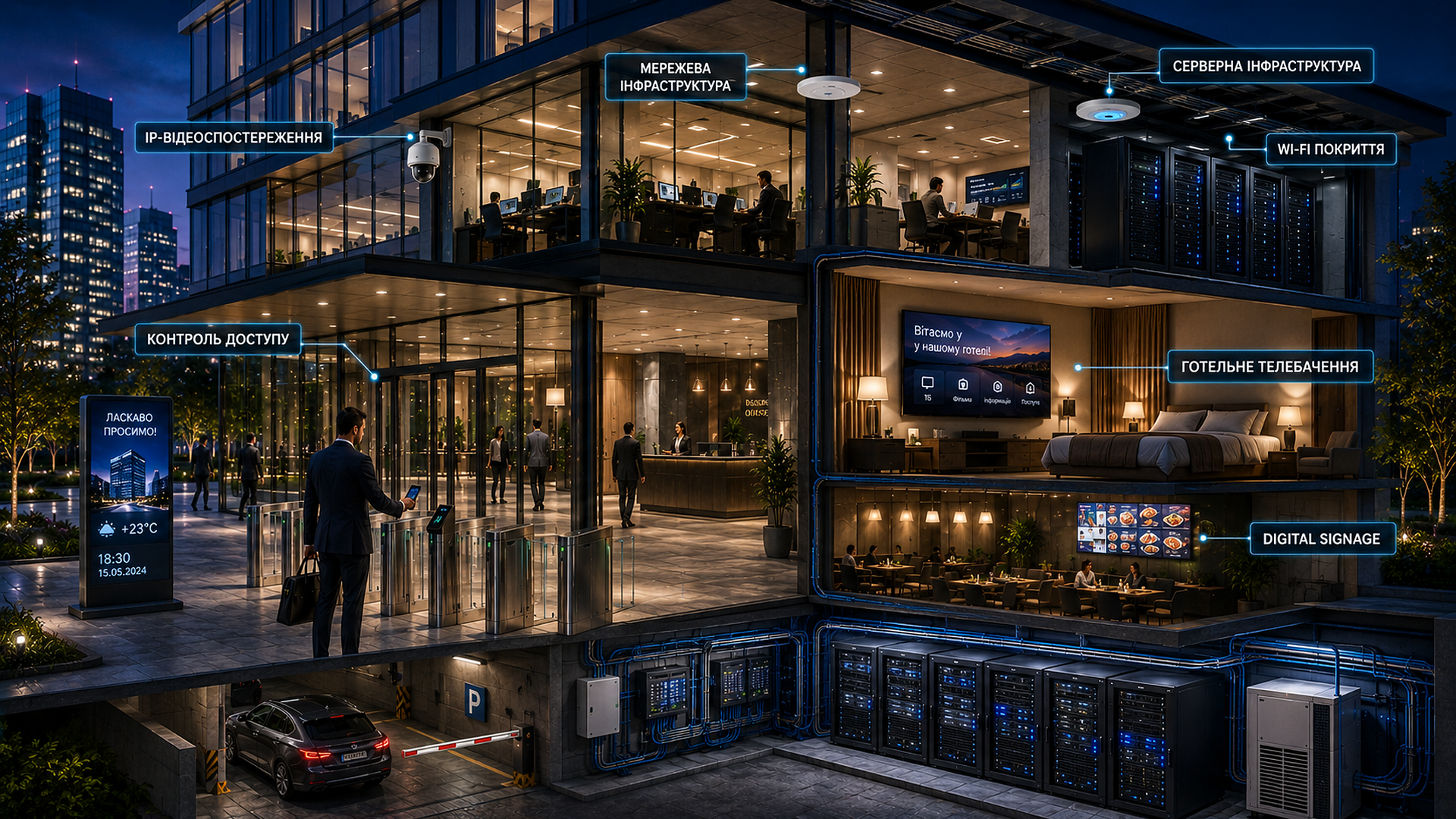
Integrated security and IT systems in a modern hotel